Demand Falls But Growth Remains

Demand Falls But Growth Remains

Mini-budget Fallout


Hello there,

We hope you have been well since the last market update. The month of October saw multiple significant changes in the socioeconomic landscape of the UK, creating uncertainty over the short-term future of the property market. Now we are in November, market data from October can begin to demystify market conditions. 

This data of course does not take into account the most recent spike in the Base Rate, which is set to further limit affordability for buyers with large mortgages.


October Statistics

In summary, the key statistics for October are:

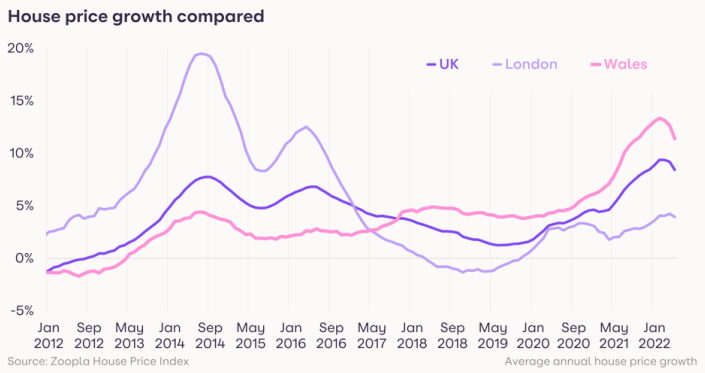
1) 8.1% average UK house price growth. Despite predictions that house price growth would slow down significantly by the end of 2022, it has only marginally fallen from a peak of around 8.4% in August. It has significantly raised from 6.9% growth at the end of last year.

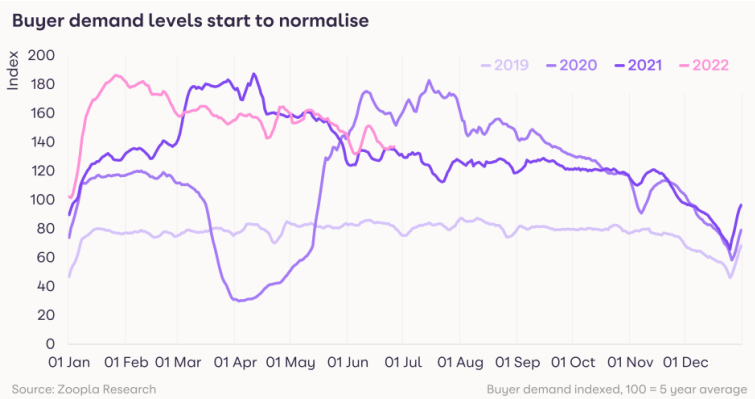
2) -33% impact on new buyer demand since the mini-budget.

3) 48% of buyers are using cash or small mortgages. These buyers are propping up the market as demand from FTB and buyers with larger mortgages falls.

House Price Outlook


Despite the fall in demand, there is no evidence that prices will be significantly impacted in Q4. For 2023, price changes will depend on mortgage rates.

Zoopla predicts that if mortgage rates stay at around 6% going into 2023, double-digit price falls can be expected next year.
If rates fall towards 4%, a modest decline in value of up to 5% can be expected in 2023. This is what had been expected to be the most likely outcome on the final day of October. But since then, the Bank of England has increased the base rate to 3%. So, it looks like mortgage rates are likely to remain high at the beginning of 2023.

Other important statistics, compared to a 5-year average, are:

1) Stock is down 13%.

2) The number of sales agreed is down 4%.

3) Overall demand is down 16%.

Market conditions are fluctuating rapidly in response to changes in government. While the market seems to be entering a period of challenging downturn for now, with the rate of changes we have seen in the past few months, this may change. We will be back next month to update you if it does.

Kind regards,

Luiz De Souza | Administrator
Housing Market Resists Economic Headwinds

Housing Market Resists Economic Headwinds

A Resilient Second-Step Market 


Hello there,

We are back again with EO’s monthly market update. This time prepared at the end of the month to be able to comment on the latest data possible. September has seen multiple major events that have impacted all of the UK, but last week was especially prevalent for the housing market.

In the same week, the Bank of England raised the Base Rate, meaning higher mortgage repayments once the change is reflected by lenders, and a new mini-budget has made significant and permanent stamp duty changes.


How has the market reacted?

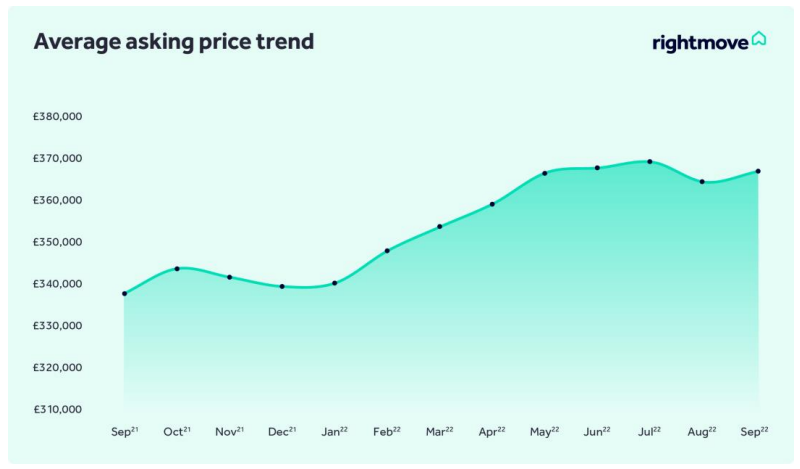
 In the face of national uncertainty, the housing market has remained surprisingly resilient. Annual house price growth sits at 8.7%, which is higher than in our last market report, even though this rate was forecast to continue decreasing towards the end of the year. Looking at it from a monthly viewpoint, the average asking price increased by +0.7% over September.

Buyer demand also endures, despite rising mortgage rates, being up 20% compared to the pre-pandemic 5-year average.

The average asking price of properties now sits at £367, 760.

Is this the same for all properties?


The continuous increase in asking price is being driven by ‘second-stepper’ properties. This includes 3 bed properties, and undetached 4 beds.

For fist time buyers, the stamp duty changes mean that 2/3 of all homes in England are exempt from stamp duty.

However, these changes were implemented recently and are in effect permanently, so its impact on the market is expected to kick in gradually rather than leading to a spike in demand.

For now, the sector of properties suitable for first time buyers, is down 8% compared to the same time last year.

This makes considering average monthly repayments for a first-time buyer is currently £1057 which is 40% of an average gross salary. This has not been the case since November 2012. The recent spike in interest rates, when implemented by vendors, could mean this average monthly cost rises to £1,114.

As always, if you would like to discuss your property plans with us, you can find our details here.


Kind regards,

Luiz De Souza | Administrator
Buyer Demand Remains Resilient

Buyer Demand Remains Resilient

Forecasts Revisited


Hello again, now we’ve reached August, and we’re back with a brand-new market update. This time around we have data from the whole first half of the year, which allows some useful insights into how well the market forecasts from the end of 2021 are doing right about now.

Let’s get right into it:


The rate at which house price growth would diminish is slower than what was expected. It was predicted that economic uncertainty brought about by rampant inflation and the cost-of-living crisis would prove a significant stopper to buyer demand. And lowering demand has now meant that the rate of house price growth is falling. But not by much. Compared to the last market report’s 8.4% growth, this month’s house price growth at the end of H1 is reported to be 8.3%.

This .1% fall means that house price growth falling to between 2-4% as projected in December is no longer feasible. Zoopla has now amended this projection to a +5% average by the end of the year.

The projected number of transactions for 2022 has also been raised by 100,000, jumping from 1.2 million to 1.3 million.

Affordability has not been as much of a restriction for demand, but it is still expected to play a greater effect in Q3 and Q4.


Resilient Demand

The resilience of buyer demand has been attributed to ongoing changes in thinking brought about by the pandemic. Chiefly, this is a result of increased flexibility in the workplace. People who expect to work from home more in the future are reportedly five times more likely to be looking to move than people whose schedules are expected to stay as they were pre-pandemic.

To contextualise this, the pandemic has more than doubled the number of workers who work from home.

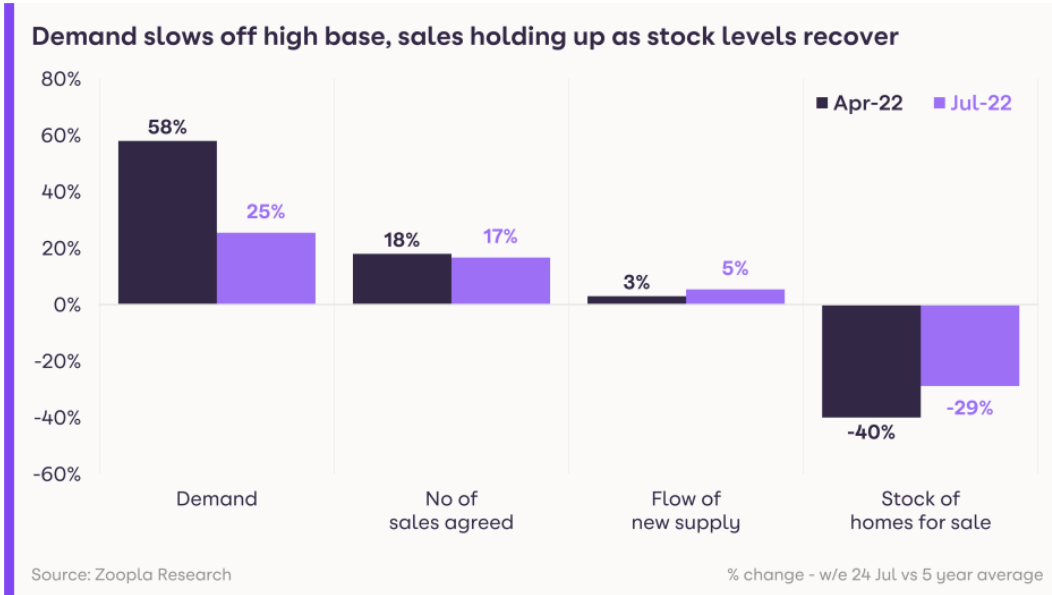
Supply has even begun to recover, rising from -40% (compared to 5-year averages) to -29% from the last market report.

All in all, major price falls are unlikely any time soon. The market has been protected from over-valuation by post-economic-crisis regulations and even with rising mortgage rates, house price growth is expected to only reach 0 at a 4% average mortgage rate. It is currently 3.5%.

If price falls do occur, they will be moderated and not the crash that some may expect.

But of course, this does not mean that taking action early and securing lower mortgage rates before they rise is no longer a worthwhile strategy for buyers. When demand falls, it will swing into a buyer’s market, so equally for vendors, listing their homes sooner rather than later may be best.

Of course, general trends can only go so far, and everyone has individual needs which are best served by a bespoke solution. So, if you would like to discuss your property plans, you can find our contact information Here.

And until the next market update, have a fantastic month.

Luiz De Souza | Administrator

Slowing Price Growth and Rising Rates

Slowing Price Growth and Rising Rates

Growth Begins to Slow


Another month has passed by, and the many changes come with it. Outside of the pressing political machinations that took place on the 7th of July, the latest data suggests that the property market is starting to feel the effects of the economic headwinds that 2022 has brought along with it.

The robust price growth that has endured in the past two years has now begun to demonstrable signs of slow-down. Last month, we spoke of house price growth on average sitting at +8.4%. This figure remains the same this time around. This means we have passed the peak of the curve, and the next market update will see house price growth on a downward trajectory.

With only half the year left, this would mean house price growth would have to fall by an average of 0.9% a month to reach the +3% growth projected for the end of the year. This is a fairly steep decline compared to the rate of growth over the past few months, but it is supported by rising interest rates and lower buyer demand.


Explaining Waning Demand

Demand was up 61% compared to a five-year average on our last report. This now sits at +40%. The over 10% dip can be accounted for  by considering price sensitivity in buyers.

For example, mortgage rates in December 2021 (for a 5-year fixed-rate loan – according to Moneyfacts) were 2.64%. This has now risen to 3.37%. To put this in context, the average annual cost of a loan for an average-priced home (£250,000) with a 25% deposit for a 25-year term has increased by £870. With a standard 10% deposit, this increase would be closer to £1,030. Mix this in with a cost-of-living crisis, brought about by inflation and raised taxes, then it can easily explain the softening demand.

Now that’s quite a few numbers. What it essentially means is that affordability for buyers will become increasingly tough in the next few months. This, considering the slowing flow of stock (down to +4% from +7%) and low overall stock (-33% vs. 5-year averages), means the time to buy is now.

If you would like to discuss your property plans in response to the changing market contact us HERE.

And until the next market update, have a fantastic month.


Luiz De Souza | Administrator

Time to Sell Rises as Affordability Dips

Time to Sell Rises as Affordability Dips

Past the Peak

Summer is near at hand, and the Jubilee has just passed. We hope you’ve been able to make the most of the special occasion and are renewed for June. The energy may certainly be needed, with growing tension in parliament and continuing global unrest. But how has the market fared since we last checked in?

According to the data leading up to the last month, the predicted flattening of the curve when it comes to property prices has finally begun to take effect. This has yet to mean price growth is diminishing, however, as it is still resting, on average across the UK, at 8.4%. This is only .1% higher than last time around, which suggests that despite continuing demand, prices have reached a natural ceiling.

Demand is unshaken, currently at +61% compared to a five-year average. The upward pressure this has put on prices means that the average property price in the UK has exceeded £250,000 for the first time.

Flow is up, (+7% vs. 5-year avr.) and stock is down (-37%). These are patterns we have seen persist through the year.


Selling Slows Down 

What has begun to swing back is time to sell. Though experiencing a significant boost earlier in the year, with properties – especially houses – selling unseasonably fast, ‘time to sell’ is now increasing. More time on the market means a greater need for reductions. Currently, one in twenty properties are having to undergo reductions of an average of 9% to entice buyers.

So, it seems that buyers are still keen to make purchases, but are being a bit more selective at what price point they enter the market. While their reasons would of course be numerous, it’d be a fair bet to say the economic headwinds we were warned about earlier in the year have begun to take effect.

They bring affordability to the forefront. Buyers must reckon with the fact that an average mortgage, on an averagely priced property, is now £852 more a year than it would have been at the start of the pandemic.

For homeowners looking to sell, it is more important than ever to stick to realistic and competitive pricing.

Here at EO, realistic, fast-selling prices are our bread and butter. So, if you have been thinking of how your property would fare in the current market, give us a call on 020 3633 8911.

Luiz De Souza | Administrator

Crystallising Gains and Looming Interest Spikes

Crystallising Gains and Looming Interest Spikes

Hello again friends of EO. Following a restful period of bank holidays in close succession, the Monthly Market Update makes its return. This May, we have figures that begin to support the trends that were predicted back at the end of 2021. And yet, some aspects of the market have stayed very much the same. 

First things first, as it has since the beginning of our market updates, house price growth continues to trend upwards. While having peaked at a +8.8% increase at some point in February, the current positive growth is +8.3%. Only 0.2% higher than last time around, but the fact the growth has continued at all has surprised those that expected growth to slow down to +3% by the end of the year. That figure now seems unlikely, even with incoming economic headwinds looming. Price growth would have to fall far too linearly for that to be feasible. 

This 8.3% figure is of course the current national average, the London price growth average has been consistently floating around +3% already (currently it is 3.4%). 

This growth is once again supported by enduring buyer demand, which is 58% higher than the five-year average. This has led to sales agreed on the run-up to Easter to be 27% higher than the average as well. Predictably, buyer demand is currently keeping up market momentum. 


First Time Buyers, Growth And Affordability 

These factors mean house price growth is at a 15-year high. But the same can be said for other statistics in the post-pandemic world, chiefly: inflation. Inflation hit 7% in March 2022. Comparing the two figures, the national price growth does edge out inflation by a small but significant margin, but in London, house price growth sits almost 4% below. 

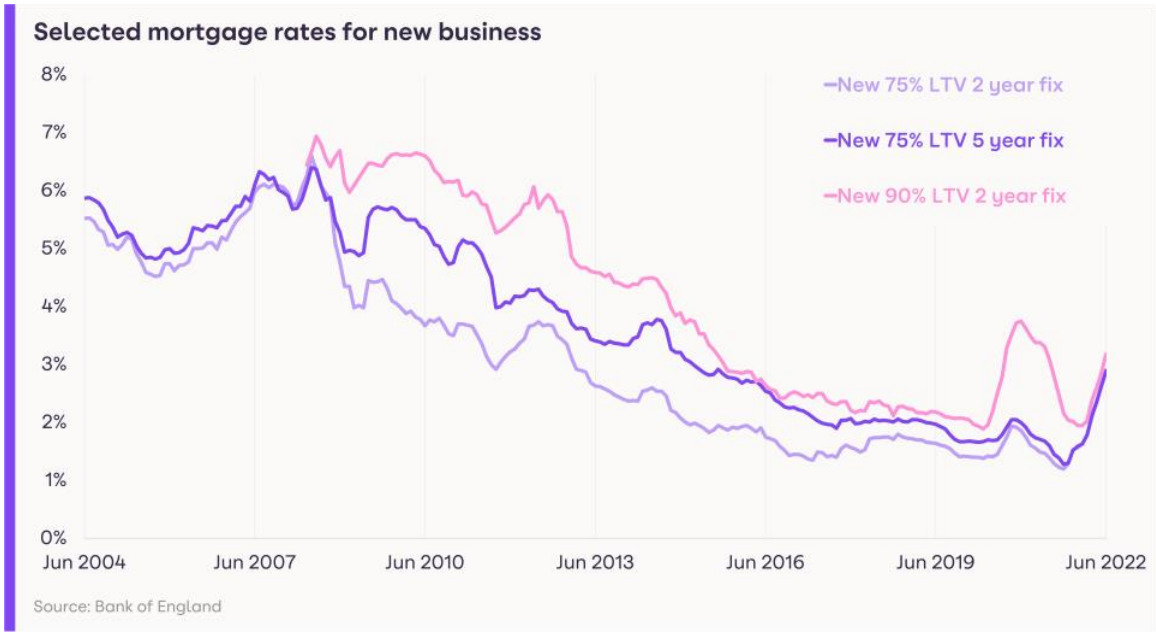
Raising interest rates is a classic strategy by banks to try and rein in inflation. But raising interest rates will also inevitably impact buyer demand. It has already fallen from 65% higher than the average to 58% since our last market update. 

Higher interest rates affect monthly repayments which impact affordability. For first time buyers, affordability has already seen major changes. The pandemic is said to have driven property prices up on average by £29,000. This has pushed millions of properties into a price threshold where stamp duty can be incurred. 

Overall, this means the average first-time buyer will need an extra ‘£4,000 for a 15% deposit, and an additional £5,000 in added income every year to meet the criteria of a home loan which is within the 4.5 x income threshold’ (Zoopla March 2022 index). Accounting for increases in the cost of living on top of this, it is easy to see why buyer demand is expected to begin dipping considerably in the second half of the year. 

And so, homeowners are now faced with the option of crystalizing their pandemic gains in house prices while demand remains high. 

But as always, statistics can only say so much, if you’d to discuss your property plans in detail, contact us HERE. 

Luiz De Souza | Administrator

EO Estate Agent