
House Price Growth Continues to Climb

House Price Growth Continues to Climb

April’s Market Round Up Rolls In!

Welcome back to EO’s monthly market updates.

We hope you have had an exciting and productive time during March, we have definitely seen a surge of activity as 2022 speeds along. I think it best to begin with the pressing question we usually tackle in these reports, is the market on the up and up?

To answer this, we can look at house price growth which from the latest data is sitting at an 8.1% increase. For the avid reader of the market updates, you might remember that at the end of last year this figure was +6.9%. So, house price growth has continued to increase for now, despite concern that the looming spikes in the cost of living and interest rates will deter buyers and therefore slow down price growth. It is certainly possible that prospective buyers are looking to act before these changes take effect, and this is therefore continuing to create upward pressure on prices. We will most likely find out which is which when the data from April becomes available.

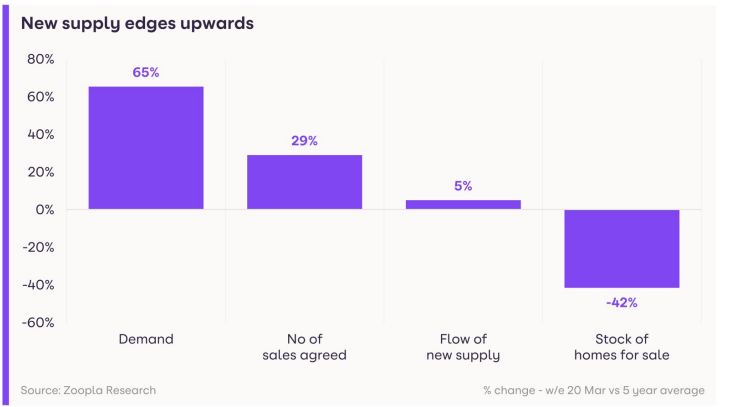
The relationship between this upward trend in price growth and buyer demand is supported by demand for homes being +65% higher than the five-year average.

The flow of new supply is still +5% higher compared to a five-year average, but considering this figure is the same as last month’s report, it suggests growing stability in the flow of supply. It could, however, signal a transition period before the flow of supply begins to dwindle once again.


Outlook for Stock Levels

A slow down in flow would rock total supply levels when considering the unseasonably high level of buyer demand, where Q1 2022 saw comparable levels of sales to Q1 2021 where the market was boosted by the Stamp Duty Holiday. In London, sales agreed have actually surpassed Q1 2021, revealing a possible trend as demand for urban areas experiences a resurgence.

Price growth motivates stock movement, especially when partnered with inflated buyer demand. All the factors above combined have resulted in overall stock for sale sits at -42% compared to five-year averages.

The sentiment seems to be then, with looming policy changes and geopolitical tension, that those looking to sell or buy should do so soon. However, while trends are useful to consider, only the individual can know what the right time to buy or sell for them is.

So, if you’re looking for more tailored and specific property advice, then feel free to give us a call on 020 3633 8911

If you’d like insight on how the market may have changed since last month, check our first market report of 2022 here.

Luiz De Souza | Administrator
Supply On The Rebound

Supply On The Rebound

2022’s First Market Update is Here!

Welcome back to monthly market updates!

We hope the first few months of 2022 have been positive and successful for you. Here at EO we are doing better than ever, having become independent in the time since our last market update. It takes a little while for enough data to gather from the beginning of the year for us to start drawing patterns for where things are going, but the time has finally come. We hope you find this March Market Update useful reading for your property plans.

Last year, an ever-increasing demand and dwindling supply saw the price of homes continue to inflate. It seems that this year, demand will not slow down, with it still being 70% higher compared to a five-year average. But that does not mean nothing has changed!

In fact, the flow of supply into the market has rebounded and is now at +5% growth. Comparing this to an index from October 2021, which saw the flow of new supply at -21%, it shows how dramatic of a jump it has been, even if the 5% figure in isolation may seem humble.

Greater supply may moderate the ongoing growth of house prices, but in fact, it secures a smoother market. This is because movers are far more likely to list their homes if they believe that they will have an easy time finding a property to move to. This leads to more transactions, and of course, more complete chains.

A Fast Moving Market

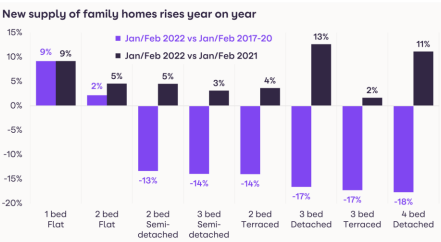
Supply is currently ahead of 2021 levels in every region.

The flow of new supply is almost at pre-pandemic levels, even if the overall total supply remains tight. Even so, the lingering effects of The Race for Space, means the average price of a property in the UK now sits at £244,100.

On top of trending upwards, price and supply-wise, the market is moving fast ­– for houses. It is found that 3-bed houses across the UK are selling within 23 days of being listed. In January, around half of all properties sold within 3 weeks of being listed. This speed means that though the flow of supply is up, it may take a while to recover total stock, as properties that are being newly listed, are also being quickly sold. In 2021, only a third of properties managed to sell in under 3 weeks in January.

Geopolitical uncertainty and incoming tax and mortgage changes may see these positive trends dampened. If potential sellers adopt a wait-and-see approach, we may see the flow of stock restricted again. Zoopla predicts that house price growth, currently at an average of 7.3% will diminish to 2-4% by the end of the year.

However, while speculation can be helpful, it is good to focus on the here and now. And for now, it seems to be the time to sell if you want to sell quickly. Especially if you own a house.

If you want to discuss the property market further, please call us on 020 3633 8911. If you want to see what the market is like for your home Click Here

Onto The New Year

Onto The New Year

2021’s Final Market Update is Here!

It has been quite an unpredictable year. As a country, we have been locking up and down, vying for vaccines, but generally just trying to get on with things. The property market has been boosted, some say unsustainably, by the stamp duty update and houses are getting progressively more popular. Space has dominated the social consciousness, whether that be maintaining it from other people or seeking more of it in our homes.

As we covered in our November 2021 edition, the market has been busy. In fact, it has been the busiest market since 2007, with 1 in 16 privately owned properties have changed hands this year. This is a significant jump from the 1 in 20 properties exchanged that was seen in 2019 ­‑  the last year the market was thought to be ‘normal’. This encouraged house price growth, which peaked in the summer, and while it is still up (increasing by 6.9%) the pace of the growth is starting to ease. It is believed by the end of 2022, the 6.9% figure will have reduced to a robust 3% growth.

Growth is not the same across the board. Due to the impact of Covid, London continues to underperform (growth-wise) compared to other large cities. Beyond that, even on a national level, the disparity between flats and houses is growing deeper. Flat price growth is sitting at 1.6%, whereas the 5-year average is 1.3%. House price growth is double its 5-year average with 8.3% growth compared to 4.2%.

Buyer motivation is set to dip due to higher mortgage rates in response to higher inflation, but demand is set to continue to outpace the limited supply, which is currently -42%. The relationship between these two factors means while house prices are set to continue increasing, the number of transactions might suffer a measurable hit. 

Taking a Closer Look

Ultimately, in the short term, these are not things to worry about. Buyers are humans, and their motivations are often more nuanced than simply buying at the lowest rates. So, while it is worth making note of, on the individual, single property level, it is best not to take for granted that the data patterns will play out as expected. What can almost be taken for granted though, is that the post-holiday market will spike, with the new year bringing renewed enthusiasm for life changes.

So, if you are a potential seller looking to get in before the competition, December is the month to get everything ready to launch for early January.

Most importantly though, enjoy the holidays!


If you would like to have a chat about next year’s market, contact us HERE.

For more on how the market has changed towards the end of this year , check out our SEPTEMBER, OCTOBER, or NOVEMBER articles.


Back to Balance

Back to Balance

Presenting November’s Round-Up Blog

Welcome back to our monthly market retrospective, now written in the wake of a new budget and anticipation for a new year. We hope 2021 has been and continues to be a time of growth for you, as it has been for us. But without further ado, let’s discuss what the market has been doing since our last report.  

It is always good to celebrate even small changes, and so we are happy to report that the 6.1% price growth that we had seen nationally over August has now risen further and sits at 6.6%. This momentum is brought about by a number of combined influences: the re-evaluation of living space brought about by lockdowns, low mortgage rates, and the lingering effects of an extended stamp duty holiday earlier in the year. Another thing to consider is the imbalance between supply and demand, with demand up 28% and the flow of new supply down by 8%. All of these things have contributed to price inflation, but a return to sustainable levels of growth is expected in 2022.  

Though 2021 sales are set to exceed 2007 highs of 1.5 million property transactions, it is expected this number will drop to 1.2 million in 2022. Alongside that, it is expected that the 6.6% figure will gradually diminish to a 3% rate of increase of house price growth. The consensus is that there will not be a cliff-drop in demand, as some may fear, but that certain 2022 changes will marginally restrict buying power and slow the rate of price inflation.

Changes, Challenges and the Future

One of these changes is the international growth of currency inflation, deemed by Chancellor Sunak as a problem that we cannot tackle alone (read more about it HERE). Another is the expected rise in mortgage rates, which despite having been in overall decline for decades, is expected to rise next year. And finally, the cost of living is expected to see a modest rise as well because of increased taxation in the 2022/23 tax year.

These challenges to price growth are not enough to cancel out the momentum of this record-setting year for the property market, especially with higher prices and higher demand incentivizing homeowners to sell. But they are worth keeping in mind as the price growth begins to slow: the housing market will not be in decline, it will be returning to balance.

But while forecasting is useful at setting expectations, it is always worthwhile to cast a glance back. Here are a few quotes from the team about 2021 so far:

Elle

‘Unexpected, unprecedented, and exciting. What a year 2021 has turned out to be. Demand for property across the country, especially London, has been something which no one could have predicted. Across the Stamp Duty deadline, properties sold at a record pace but still with sensitive pricing within the London market. In the market we are seeing currently, flats are a harder sell than houses, with lockdowns from the pandemic having a monumental impact on people’s perspective of how they wish to live.

Homes with outside space also take presidency over those without. Within 2022, we expect to see home buyers move back into London with the market taking an upward turn with the slow return to ‘normality’. Throughout this time, our approach has been bespoke and we have offered high service levels for our clients. We will continue to proceed with this and grow in strength moving into 2022.’

Katherine

‘2021 has been a year of learning how to live with a new normal. Whilst Coronavirus is now an established part of our lives, we have had to adapt to working around it. There has been no cliff-edge in terms of demand falling, and demand for houses in particular has built in the last 18 months, driven by a number of factors.

We expect the property market to return to more normal levels in 2022, rather than the peak of 2021, assisted by the Stamp Duty Holiday, and we expect to strengthen our offering for our clients and consolidate our position as the best new agency in the area.’

Emma

‘2021 saw the likes of the highest average property price on record in London at a staggering £525,893, as well as a +56% increase in buyer demand and for EO Estate Agents, a whopping average of 99% of asking price offers for our vendors over the last 8 months.

We have found it to be an extremely busy and rewarding year so far and due to the house price gains we have already experienced this past year and the predicted +3% increase in house prices in 2022 we anticipate seeing more sellers take to the market in an effort take advantage of the great demand. We at EO are as eager and motivated as ever to assist all of our clients in achieving the best price possible in this continuously buoyant market.’

If you would like to discuss the market further, contact us HERE.

For more on how the market is changing monthly, check out our SEPTEMBER and OCTOBER articles.


The Big Squeeze

The Big Squeeze

Welcome back to our monthly blog!

We are here to keep you in the know regarding the market outlook locally and at large. In our September 2021 edition, we touched on the chief motivations of buyers and the quest for more space, which was driving up house prices compared to the same time last year. Working from figures from July and August, this pattern has largely held. Currently, the house price growth nationally rests at 6.1%, marginally up from the 6% growth that was seen in July.  

This continuous growth is propagated by an imbalance between demand and supply in the market. Demand for homes is up 19% from the same time in 2020, and yet the flow of new supply rests at -5%. Considering that the July figure for this was -3% and that the overall stock of homes for sale is down 28%, stock may become increasingly sparse as the year comes to an end. More buyers and fewer houses of course, creates upward pressure on property prices. This upward pressure is felt in London as well, but not as strongly, with house price growth sitting around a third of the overall national (2.2%). 

Demand in London

Demand, however, is picking up in London, as offices re-open and travel restrictions are lifted, with a rise of 14% over August. We can expect that the 2.2% figure will continue to grow, as more buyers compete for supply that is becoming increasingly squeezed. This comes as surprise for those who believed that buyers’ increased activity was due to the extended stamp duty holiday savings. Although it only came to an end on 30 September, for any home going under offer during July or August, it would be very unlikely that the sale would be able to complete in time to take advantage of the holiday. This means that, in terms of understanding buyer motivation at large, the re-evaluation of homes brought about by multiple lockdowns and the consequent search for increased living space, is a stronger explanation for the growing demand. And this pattern is expected to last until at least the end of this year. 

On top of driving up house prices, this imbalance also affects the time properties spend on the market. In short, the market is moving quickly. On average, houses are spending less than 30 days on the market. Anecdotally, here at EO, things are moving even faster. Within the last month, we have sold subject to contract three properties in less than 14 days: Domelton House in SW18, Jersey Road in SW17, and Morval Road in SW2. All three properties went under offer after only one day of viewings, and Jersey Road had offers in only a week after coming online.  

It may be possible that the squeeze in supply will cause a self-limiting impact on the market, but with the expected cliff-edge drop in demand from the end of the stamp duty holiday never coming to pass, and the lasting effects of the ‘race for space’, now is the time for homeowners to sell and sell quickly.  

If you would like to hear more about the property market, and how to leverage the current situation to achieve the best results for yourself, CONTACT US

To learn more about the race for space, CLICK HERE

The Race For Space

The Race For Space

Welcome to our September Blog!

We are seeing a real ‘Back to School’ vibe in the past few weeks, and we anticipate that we will be having a busy autumn.

What we are seeing in the property market at the moment is that there are lot of buyers out and about, looking for their next new home, and a real lack of properties coming to the market. This squeeze on supply coupled with the boom in demand, has been pushing the house prices up, which are up 5.4% country-wide from August 2020.

A national view, however, can often mask important details in the local markets. The 5.4% figure is reflective of increases in property prices elsewhere in the country, when in fact, the London market has slightly softened. Even nationwide, the figure fails to account for the differential between flat and house price growth. The confident 7.3% growth of house prices is best looked at alongside the more sober 1.4% growth of flat prices. This difference, of course, makes sense given the increased demand for living space.

What Does This Mean For South London?

Well, working from figures from the end of June, London has been polarised by the pandemic-driven buying pattern. Overall, London’s home price growth is currently running at 2.3% compared to the national 5.4%, but demand for Outer London properties is still 83% higher than it had been in 2017-2019 — a period thought to be more indicative of the ‘normal’ market. The race for space has meant their outdoor areas are drawing domestic interest from the centre and its cluster of flats.

These patterns have been explained as a result of social and cultural change. The pandemic has redefined our relationships with the spaces in which we live. Months at home have left many of us longing for a new office, especially when some roles are transitioning to permanent work-at-home. More prevalent still perhaps is the desire for outdoor space, which, bolstered by the prolonged stamp duty holiday, continues to drive the desire to relocate.

The pandemic has played its part in another way as well, as it has curtailed some international investment into the prime Central London market. While the market has dipped, however, boroughs south of the river maintain positive annual growth, landing between 0% and 1%. However, with restrictions lifting and many properties coming to market in September and early October, it is likely we will see this changing soon. This is accompanied by the extension of the stamp duty holiday, which can mean savings of up to £2,500 and will last until the end of September.

This optimism is supported by changes in the rental market. Being quicker to adapt to societal change, it has already experienced an uptick in demand for areas in Central London, as people are more likely to start working back in the office at least part of the time.

If the uptick in demand carries into the sales market it will be great news for vendors in September and October who will be looking to be in new homes by Christmas.

If you want a more in-depth look at the property market and what this means for you and your property, please don’t hesitate to contact us HERE


EO Estate Agent